What Is a Good Gaming PC Budget in 2026?
If you are wondering what is a good gaming pc budget, the short answer is $800 to $1,200 for most players, but the honest answer depends entirely on your resolution and the games you love. A comfortable 1080p machine costs far less than a serious 4K rig, and spending more than you need is just as common a mistake as spending too little. Here I break down what is a good gaming pc budget at every tier, with real part prices and the frame rates you can expect from each one.
What Is a Good Gaming PC Budget? The Short Answer
A good gaming pc budget is one that fits your target resolution without forcing you to replace parts a year later. For 1080p gaming, roughly $700 to $900 is the sweet spot. For 1440p, plan on $1,200 to $1,500. For smooth 4K, expect $1,800 to $2,500. These ranges hold true through early 2026 pricing and assume you are buying everything new.
Budget tiers at a glance
The table below summarizes what is a good gaming pc budget for each target and what performance that money realistically buys.
| Budget Tier | Price Range | Target Resolution | Expected Performance |
|---|---|---|---|
| Entry level | $500-$700 | 1080p low-medium | 60+ fps in esports |
| Mid-range | $800-$1,200 | 1080p high / 1440p medium | 100+ fps esports, 60+ fps AAA |
| High refresh 1440p | $1,300-$1,700 | 1440p high | 100+ fps AAA |
| 4K / enthusiast | $1,800-$2,500+ | 4K high | 60+ fps AAA |
These numbers are a starting point, not a hard rule. Your regional pricing, monitor, and whether you reuse any parts all move the final figure up or down.
What the Money Actually Buys at Each Tier
Knowing what is a good gaming pc budget is only useful if you understand where the money goes inside the machine. In every tier, the graphics card claims the largest single share, followed by the CPU and then the motherboard and memory.
The $700 entry build
Around $700 buys a Ryzen 5 or Core i5 paired with a $200-to-$250 graphics card, 16GB of memory, and a 500GB SSD. That comfortably clears 60 fps at 1080p in esports and handles AAA titles at medium settings. It is the minimum I would recommend for a genuinely enjoyable experience.
The $1,000 to $1,200 mid-range build
This is the value peak. Here you get a six-core CPU, a $300-to-$400 GPU like a Radeon RX 7700 or RTX 5060 Ti, 32GB of memory, and a 1TB or 2TB NVMe drive. It pushes 1080p high well past 100 fps and is the natural choice if you own a 1440p monitor. My best gaming pc build 2026 guide details a build in exactly this range.
The $1,500 to $2,000 enthusiast build
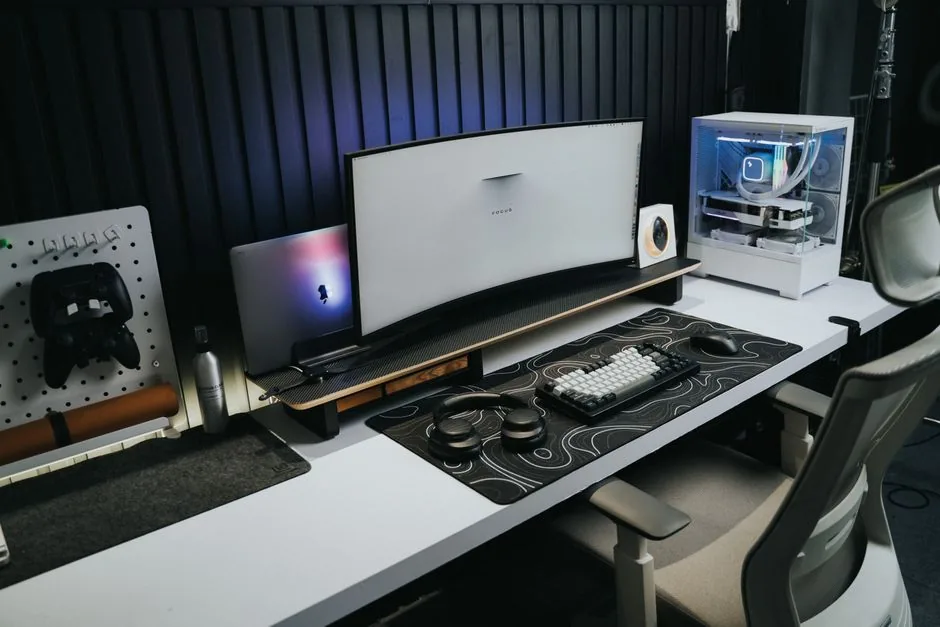
Step into this range and you are buying a serious machine: a strong eight-core CPU, 32GB of fast memory, and a $500-to-$700 graphics card capable of 1440p high above 100 fps. This is also where 4K becomes realistic, if not effortless. For a complete cost breakdown at this level, see my how much does it cost to build a gaming pc guide.
What Influences Your Budget Most
Three factors move a gaming pc budget more than anything else: your monitor’s resolution, how much you care about ray tracing, and whether you need the machine to do double duty for work or streaming.
Resolution is the real driver
Resolution sets the graphics card requirement, and that is the most expensive part. A 1080p card and a 4K card can differ by $500 or more. If you are still on a 1080p monitor, a good gaming pc budget is far lower than for someone pushing 4K 120Hz.
Ray tracing and future titles
If you insist on maxed-out ray tracing or path tracing, shift your budget up a tier to afford a stronger GPU. If you are happy with rasterized performance, the same money goes much further. My best gpu for gaming price to performance guide helps you find that value point.
Other gear you already own
A reusable case, power supply, or storage drive can trim $100 to $200 off a new build. If you have parts worth carrying over, factor them in before settling on a budget.
Don’t Forget the Peripherals and Monitor
A gaming pc budget rarely accounts for the monitor, keyboard, and mouse, yet those are essential to the experience. A high-refresh monitor alone commonly costs $200 to $400. If you are starting from nothing, add that to your total. My best gaming monitor 2026 guide lists solid options at every price point.

Independent buyers guide resources like Tom’s Hardware and PC Mag publish continuously updated build guides that are worth cross-referencing before you commit your budget.
Sample Builds at Key Price Points
To make what is a good gaming pc budget tangible, here are three concrete configurations at the prices that matter most, reflecting early-2026 pricing on all-new parts.
At $700, you are looking at a Ryzen 5 7600 or Core i5-14400F paired with a Radeon RX 7600 or RTX 4060, 16GB of DDR5, and a 500GB SSD. This is the classic 1080p starter build.
At $1,000, step up to 32GB of memory, a 1TB NVMe drive, a stronger power supply, and a graphics card like the RX 7700 XT or RTX 5060 Ti. This is the comfortable 1440p sweet spot.
At $1,500, you get an eight-core Ryzen 7 9800X3D, 32GB of fast memory, and a $500-to-$600 GPU that handles 4K with the right settings. My best budget gaming pc build under 1000 guide has a full parts list for the mid-range tier.
Buying Used vs. New to Stretch Your Budget
A good gaming pc budget can be stretched further by buying a used graphics card or CPU, which are the two safest components to purchase second-hand. A previous-generation GPU frequently sells for 40 to 50 percent below its original price and still delivers excellent performance. Memory, storage, and power supplies are best bought new, because failures there cause more headaches than the savings justify.
If you go the used route, buy from a platform with buyer protection, ask for a benchmark screenshot or a short test video, and confirm the card has not been mined on for years. A little caution turns second-hand parts into one of the smartest ways to build a strong machine for less.
How to Plan Your Budget Step by Step
Figuring out what is a good gaming pc budget is easier as a short process. First, pick your target resolution and refresh rate, since that sets the graphics card requirement. Second, decide whether you will reuse any parts. Third, list the core components and price them with current retail numbers rather than outdated guides. Finally, add a 10 percent buffer for shipping, taxes, and small parts like fans and cables that add up quickly.
Following that order keeps you away from the most common budgeting error, which is choosing a number first and then trying to force a build to fit it. Let the target performance set the budget, not the other way around.
FAQ
What is a good gaming PC budget for 1080p?
For 1080p gaming, a budget of $700 to $900 is ideal. That buys a machine that clears 100 fps in esports and handles AAA titles at high settings without straining.
Is $1,000 enough for a gaming PC in 2026?
Yes, $1,000 is enough for an excellent 1080p and capable 1440p machine. It sits right at the value peak where you get strong performance for every dollar spent.
Can you build a gaming PC for $500?
You can build a basic 1080p machine for $500, but it will lean on lower settings and leave little upgrade headroom. Stretching to $700 delivers a noticeably better experience.
How much should a 4K gaming PC cost?
A 4K gaming PC typically costs $1,800 to $2,500, driven mostly by the high-end graphics card required to push 4K at playable frame rates.
What is the most expensive part of a gaming PC?
The graphics card is almost always the most expensive component, often accounting for a third or more of the total budget. The CPU is the second-largest expense.
Can I reuse parts from my old PC to lower the budget?
Yes, a case, power supply, storage, and even memory can carry over and shave $100 to $200 off a new build. Just confirm the power supply has enough wattage and the case fits your new parts before reusing them.
Conclusion
So what is a good gaming pc budget? For most people the answer lands between $800 and $1,200, where you get the best balance of price and performance. Match your budget to your monitor’s resolution, prioritize the graphics card, and you will get a machine that feels fast for years instead of one you outgrow in months.