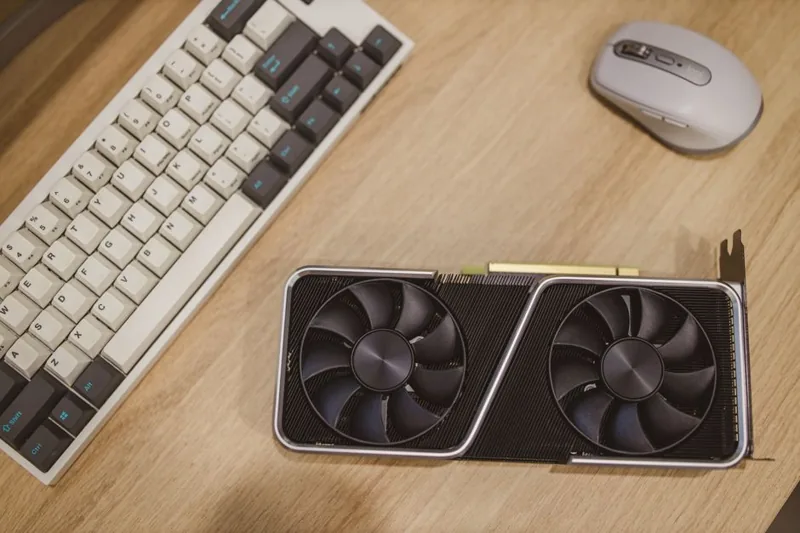
Intel Arc B580 Review: The Budget GPU That Shocked 2026
This Intel Arc B580 review covers the card that finally made Intel a serious contender in the graphics market. Priced at just $249, the Arc B580 pairs 12GB of GDDR6 memory with Intel’s second-generation Battlemage architecture, delivering performance that embarrassed the RTX 4060 and RX 7600 at launch. Eighteen months after release, mature drivers have only widened its lead. If you’re building a budget gaming PC in 2026, this is the card everyone should be talking about — here’s my full Intel Arc B580 review.
Specifications and Architecture
The Arc B580 is built on Intel’s Xe2 “Battlemage” architecture, a ground-up redesign that fixes nearly every weakness of the first-gen Alchemist cards. Key specs include 20 Xe2 cores, a 2.67 GHz boost clock, and 12GB of GDDR6 on a 192-bit bus delivering 456 GB/s of bandwidth. The 12GB frame buffer is the standout — it’s 50% more than the RTX 4060’s 8GB, and that headroom matters enormously in modern titles. Official specifications are available on Intel’s Arc B580 product page.
Critically, the B580 draws just 190W from a single 8-pin connector, meaning it drops into almost any existing system without a power supply upgrade. That alone makes it the easiest budget upgrade path for prebuilt owners.
1080p Performance: Where It Shines
At 1080p, the B580 is genuinely excellent. Across a modern game suite it averages 80-100 fps at high-to-ultra settings, often beating the RTX 4060 by 10-15% while undercutting it on price. Games like Cyberpunk 2077, Fortnite, and Call of Duty all run comfortably above 60 fps at max settings, and esports titles push well past 144 fps.
The 12GB of VRAM means texture-heavy titles like Hogwarts Legacy and The Last of Us Part I run without the stuttering that plagues 8GB cards at high settings. That’s a real, tangible advantage at this price point, and it’s the single biggest reason this card holds up so well a year and a half after launch.
1440p: Capable With Caveats
At 1440p the B580 holds up surprisingly well for a $249 card, delivering 50-70 fps in demanding titles at high settings. You’ll need to enable Intel’s XeSS upscaling or drop to medium settings for the heaviest games, but for a smooth 1440p experience on a budget monitor, it’s genuinely viable — something no previous sub-$300 card could claim with confidence.
Drivers: From Problem to Strength
The first-gen Arc cards were notorious for driver issues, and this is the most important part of any Intel Arc B580 review. The good news: Intel has fixed the vast majority of problems. Day-one support for new releases is now the norm, and the DX9/DX11 performance penalties that plagued Alchemist are largely gone.
The one remaining caveat is older, niche, or indie titles that occasionally run into quirks. If you primarily play mainstream and recent games, you’ll likely never notice. Intel’s monthly driver cadence has also steadily improved performance — the card is measurably faster today than at launch.
Ray Tracing and XeSS
The B580 includes dedicated ray tracing hardware, and while it can’t match NVIDIA’s RT performance, it runs light-to-moderate ray tracing at 1080p comfortably. Intel’s XeSS 2 upscaler is a genuine DLSS competitor now, with frame generation that keeps demanding titles smooth. For a $249 card, this feature set is remarkable — ray tracing plus upscaling was unthinkable at this price two years ago.
Intel Arc B580 Review: Specifications Table
| Spec | Intel Arc B580 |
|---|---|
| Architecture | Xe2 (Battlemage) |
| Xe2 Cores | 20 |
| Boost Clock | 2.67 GHz |
| Memory | 12GB GDDR6 |
| Memory Bus | 192-bit |
| Bandwidth | 456 GB/s |
| Power Draw | 190W |
| Connector | 1x 8-pin |
| Launch MSRP | $249 |
How It Compares to the Competition
Against the RTX 4060, the B580 is simply better value: more VRAM, equal or better rasterized performance, and a $50 lower price. Against the Radeon RX 7600, it’s again ahead on both VRAM and value. NVIDIA’s DLSS and AMD’s FSR are more mature than Intel’s XeSS, but XeSS 2 has closed most of the gap and supports frame generation. For the full market picture, see our best graphics card for gaming 2026 and best GPU for gaming price-to-performance guides. Long-running outlets like Tom’s Hardware keep head-to-head budget GPU charts updated as new drivers land.
Power, Thermals, and Noise
The B580 is a well-behaved card. Its 190W board power and single 8-pin connector keep total system demands low, and partner coolers from ASRock, Sparkle, and Acer run quiet and cool — typically in the low 60s Celsius under load. That means it fits not just in new budget builds but also in older office PCs that owners want to convert into gaming machines, provided the power supply has a spare 8-pin connector.
Availability, Partner Models, and Pricing
The B580 ships from a healthy roster of board partners, including ASRock, Sparkle, Acer (the Predator line), and Gunnir. Prices start at $249 for the entry models and climb to about $280 for triple-fan versions with factory overclocks. Supply has been steady through 2026, which is itself a win for Intel — the card has rarely suffered the scalper-driven price spikes that plagued NVIDIA and AMD launches.
When shopping, the differences between partner cards are mostly cosmetic: cooling design, noise, and a small factory overclock. A $259 dual-fan model is the sweet spot, and there’s little reason to pay more unless you specifically want the quietest or flashiest variant.
Overclocking and Undervolting
The B580 responds well to light tuning. Intel’s Arc software includes a straightforward overclocking interface, and most cards can sustain a modest 100-150 MHz boost-clock increase with a small power-limit bump. More interesting is undervolting: dropping the voltage curve a touch reduces power draw and fan noise while preserving nearly all performance, which is ideal for compact or quiet builds.
None of this is required — the card is well-optimized out of the box — but it’s nice to have the headroom if you enjoy tinkering.
Who Should Buy the Arc B580
The Intel Arc B580 is the obvious choice for three buyers: budget builders assembling a PC around $700-900, prebuilt owners wanting a cheap drop-in upgrade, and anyone who wants 1440p capability without paying $400+. If that’s you, our best budget gaming PC build under $1000 guide pairs perfectly with this card.
It’s less ideal for ray tracing enthusiasts (RT performance trails NVIDIA), and content creators who rely on CUDA-accelerated apps should stick with NVIDIA. For pure gaming value per dollar, though, nothing else comes close.
B580 vs B570: Which Battlemage Card?
Intel also sells the cheaper Arc B570 at $219, and it’s worth a moment to decide between the two. The B570 steps down to 10GB of VRAM on a 160-bit bus and a slightly lower clock, which puts it about 10-12% behind the B580 in gaming. At only a $30 price difference, the B580 is almost always the smarter buy — that extra 2GB of VRAM and wider memory bus deliver more longevity for a trivial premium.
The B570 only makes sense during deep sales or if you’re building an extreme-budget machine and every dollar counts. For the vast majority of buyers, the B580’s 12GB configuration is the one to get, and it’s why this Intel Arc B580 review recommends it so strongly over its own sibling.
FAQ
Is the Intel Arc B580 good for gaming?
Yes. It delivers excellent 1080p performance and even handles 1440p at reduced settings, outperforming the RTX 4060 in most games while costing less and offering 12GB of VRAM.
Does the Arc B580 support ray tracing?
Yes, it has dedicated ray tracing hardware, though RT performance trails NVIDIA’s competing cards. For most games at 1080p, it’s still playable with ray tracing enabled.
What power supply does the Arc B580 need?
Just a 550W unit with a single 8-pin connector. Its 190W draw means it fits almost any existing system without an upgrade.
Is the Intel Arc B580 good for 1440p?
It’s capable at 1440p with high settings and XeSS enabled, making it the cheapest card that can genuinely handle 1440p gaming on a budget.
Are Intel Arc drivers still buggy?
No. While the first-gen Alchemist cards had issues, the B580’s Battlemage drivers are now mature, with solid day-one support for major releases and only occasional quirks in older niche titles.
Final Verdict
This Intel Arc B580 review concludes with a simple verdict: the B580 is the best budget graphics card of 2026, full stop. With 12GB of VRAM, mature drivers, and $249 pricing, it delivers performance that cards $100 more expensive struggle to match. Intel has finally arrived in the GPU market, and budget builders are the clear winners.