RX 9070 XT Build: The Complete $1,500 1440p Gaming PC Guide
The RX 9070 XT is the best value high-end GPU AMD has shipped in years, and building around it is the smartest way to get flagship-class 1440p and capable 4K performance without paying Nvidia’s premium. This rx 9070 xt build pairs the card with a balanced part list that avoids bottlenecks at either end, delivering smooth triple-digit frame rates in almost everything at 1440p for around $1,500.
The RX 9070 XT is built on AMD’s RDNA 4 architecture with 16 GB of GDDR6 memory, which is its quiet killer feature. At its roughly $549–$599 street price, it undercuts Nvidia’s comparable cards while carrying enough VRAM to stay relevant for years. Pair it with the components below and you get a rig that makes sense today and has room to grow.
The RX 9070 XT at a Glance
Before the part list, here is what the card itself brings to the table. It competes directly with the RTX 5070 Ti, trading blows in rasterization and offering strong but not class-leading ray tracing, all while typically carrying more memory for less money.
| Spec | RX 9070 XT |
|---|---|
| Architecture | RDNA 4 (4 nm) |
| Stream processors | 4,096 |
| Memory | 16 GB GDDR6 |
| Memory bus | 256-bit |
| Memory bandwidth | 640 GB/s |
| TDP | 304 W |
| Typical price | $549–$599 |
| Target | 1440p high-refresh / 4K medium-high |
The 16 GB buffer is the headline. Several 2026 titles already exceed 12 GB at 1440p with maxed textures, and the RX 9070 XT’s headroom means it will not choke the way 12 GB cards are starting to.
Full RX 9070 XT Build Part List
Here is the complete parts list with real 2026 pricing. Total lands just under $1,500 before tax.
| Component | Part | Price (USD) |
|---|---|---|
| GPU | AMD Radeon RX 9070 XT (16 GB) | $579 |
| CPU | AMD Ryzen 7 9800X3D | $399 |
| Motherboard | B650E ATX (ASRock/B350E or MSI) | $169 |
| Memory | 32 GB (2×16) DDR5-6000 CL30 | $99 |
| Storage | 2 TB PCIe 4.0 NVMe (WD SN850X) | $119 |
| Power Supply | 850 W 80+ Gold ATX 3.1 (Corsair RM850x) | $129 |
| CPU Cooler | 240 mm AIO or dual-tower air cooler | $79 |
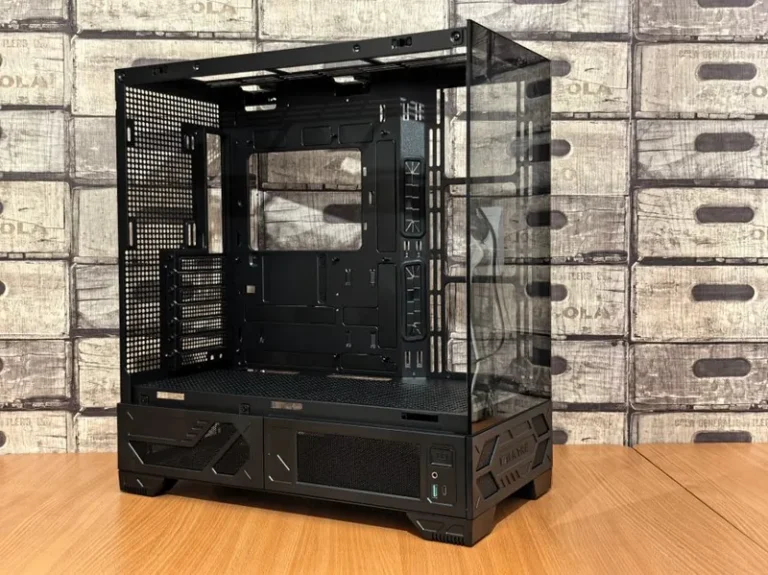
| Case | Mesh-front ATX mid-tower | $89 |
| Total | ~$1,462 |
Every part earns its place. The Ryzen 7 9800X3D is the highest-performing gaming CPU on the market and ensures the GPU is never starved for frames at 1440p. The 850 W power supply gives the 304 W card comfortable headroom, and 32 GB of DDR5-6000 CL30 memory preserves 1% lows in busy scenes.
Why This CPU and GPU Pairing Works
Bottleneck math matters more at 1440p than people think when 1% lows are considered. The Ryzen 7 9800X3D’s 3D V-Cache delivers some of the best low-frame-rate consistency of any processor, which is exactly what a high-refresh 1440p monitor needs. In CPU-heavy titles such as competitive shooters and simulators, this pairing holds minimums well above 144 FPS, while the RX 9070 XT handles the pixel-pushing. If you want to sanity-check any other combination, our GPU bottleneck calculator will show you where the ceiling sits.
Performance Expectations
With this exact build you can expect the following at typical settings:
- 1440p Ultra — 120–180 FPS in most AAA games; ray tracing on high drops heavier titles to the 90–120 range.
- 4K medium-high — 80–120 FPS, comfortably playable, and the card reaches triple digits in well-optimized titles.
- Esports (1080p/1440p competitive) — 240+ FPS in Valorant, CS2, and Rainbow Six Siege.
Those numbers make a 1440p 165–180 Hz monitor the natural companion. Anything faster than 240 Hz is wasted outside esports titles. If 4K is your goal, keep expectations realistic: this class of card excels at 4K medium-to-high, so a 4K 120 Hz panel is a far better pairing than a 4K 240 Hz flagship display you would never fully utilize.
Build and Setup Tips
A few practical notes before you start assembling. First, the RX 9070 XT is a three-slot card in most variants — confirm your case has the clearance, and route the three 8-pin (or single 12V-2×6 adapter) power cables cleanly. Second, enable Resizable BAR (AMD SAM) in the BIOS after your first boot; it is worth a small but free performance bump. Third, install the latest Adrenalin driver directly from AMD’s Radeon software page and turn on FSR 4 upscaling for demanding titles. If you want to confirm where this card lands against Nvidia’s alternatives, the Tom’s Hardware GPU hierarchy is a reliable reference.
For cooling, a 240 mm AIO or a strong dual-tower air cooler is plenty for the 9800X3D, but make sure the mesh front of your case actually ships with intake fans — many budget cases omit them. Our best airflow PC case guide covers cases that keep this exact configuration running cool and quiet.
Storage, Memory, and Power Choices Explained
Every supporting part in this list was picked for a reason, and cutting the wrong corner is where budget builds usually go wrong. On memory, 32 GB of DDR5-6000 CL30 is the modern sweet spot: it is only about $25 more than 16 GB, it removes stutter in open-world and streaming workloads, and the low CL30 latency protects 1% lows, which matter more for feel than raw average frame rate.
On storage, a 2 TB PCIe 4.0 NVMe drive is the quiet workhorse. Modern games routinely exceed 100 GB, so 1 TB fills up almost immediately once you own three or four AAA titles. The drive brand matters less than the tier — look for a drive with DRAM cache for sustained writes, since that keeps loading and shader compilation smooth.
On power, resist the urge to save $20 with a 650 W unit. The card can pull over 300 W on its own and transient spikes can momentarily exceed that. An 850 W 80+ Gold unit with native 12V-2×6 support gives you comfortable headroom, cleaner voltage under load, and room to drop in a hungrier card later without rebuilding. Our best power supply for gaming PC guide details the specific units worth buying and the ones to avoid.
Frequently Asked Questions
Is the RX 9070 XT good for 1440p gaming?
Excellent. It is one of the strongest 1440p cards available, holding 120 FPS or more in almost every title at Ultra settings, with enough headroom for high-refresh monitors.
How much power does an RX 9070 XT need?
The card draws up to 304 W, so a quality 750 W or 850 W power supply is recommended. An 850 W 80+ Gold unit gives comfortable headroom for this build’s full load.
What CPU pairs best with an RX 9070 XT?
The Ryzen 7 9800X3D is the ideal gaming pairing, though a Ryzen 7 9700X or Core Ultra 7 will also work well. See our best CPU for gaming in 2026 for more options.
Does the RX 9070 XT build work for 4K gaming?
Yes, at medium-to-high settings or with FSR 4 enabled it is a capable 4K card. For maxed-out native 4K at high refresh, you would step up to a higher-tier GPU.
What monitor pairs best with this PC?
A 27-inch 1440p 165–180 Hz IPS or QD-OLED panel is the ideal match, using the full frame-rate headroom without needing 4K. For competitive players, a 1440p 240 Hz panel is also an excellent fit.
Conclusion
This rx 9070 xt build hits the performance-per-dollar sweet spot of 2026. For around $1,500 it delivers a flagship-gaming experience at 1440p and a genuinely capable 4K machine, all anchored by a GPU with the memory headroom to stay relevant for years. The parts are balanced, the upgrade path is open, and there are no obvious weak links.
If you want to compare this build against the Nvidia side, our RTX benchmark comparison lines up the RTX 5070 Ti and friends, and the best gaming PC build for 2026 guide shows how different budgets stack up.